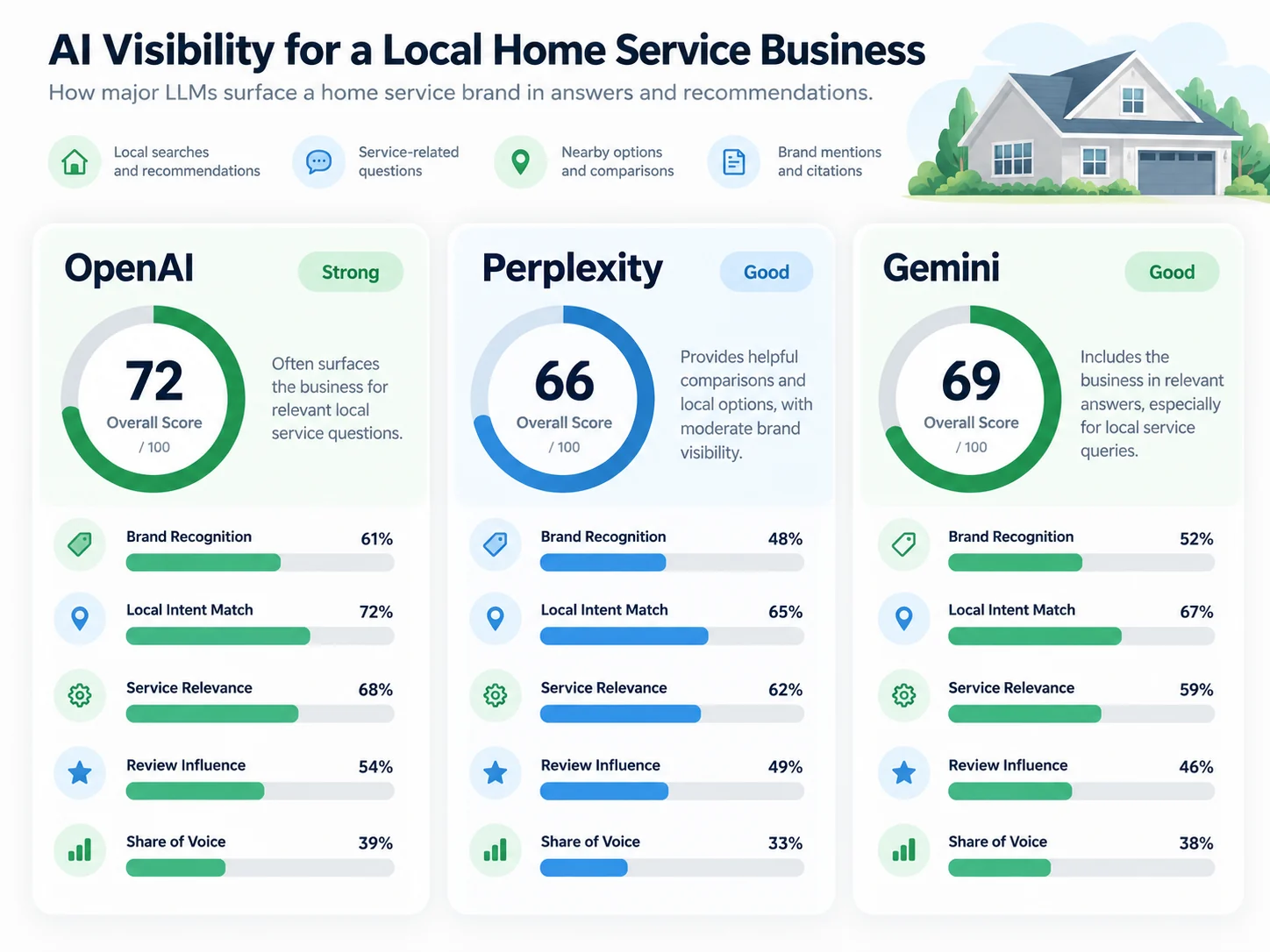
AI Search Visibility for Local Businesses in Metro Atlanta
AI-powered search experiences are becoming another way people research businesses, services, and local providers. CoreX helps Metro Atlanta businesses establish a visibility baseline, identify technical and content gaps, improve the information they control, and repeat the same tests to see what changed.
Search Is No Longer Limited to Traditional Results
Businesses can now be discovered through traditional search results as well as AI-powered experiences such as ChatGPT Search, Google AI Overviews and AI Mode, Perplexity, and other search and answer tools. These platforms do not all work the same way, and no outside company controls which businesses they mention, cite, or recommend.
CoreX focuses on the parts a business can control: a clear and accessible website, accurate business information, useful content, consistent service and location details, and a documented process for measuring visibility over time.
What We Review
Start With What Appears Today
Business Visibility
We test selected questions related to the business, its services, and its market to document whether the business appears in the responses reviewed.
Competitor Visibility
We document which competing businesses appear for the same selected questions when relevant.
Sources & Citations
Where a platform provides sources or citations, we review which websites are being surfaced and whether the business's own website appears.
Website Accessibility
We review whether important public pages are crawlable, indexable, internally connected, and available to relevant search systems.
Business & Entity Clarity
We review whether the business name, services, location, service area, and other factual information are presented clearly and consistently.
Content Coverage
We review whether the website clearly answers relevant questions about the business, its services, process, location, and customer needs.
Baseline
Establish a Repeatable Starting Point
CoreX begins with a defined set of questions related to the client's business, services, market, and customer needs. We test those questions across selected AI-powered search or answer experiences and document what appears at that point in time.
What the baseline documents
Question tested
Platform reviewed
Whether the business appeared
Relevant competitors that appeared
Sources or citations shown, when available
Key observations
Recommended next steps
AI-generated responses can vary based on the platform, wording of the question, location, user context, product changes, and time. The baseline is a documented snapshot, not a traditional ranking report.
Technical & Content Review
Review the Information Search Systems Can Access
After the baseline, CoreX reviews the website and public business information for issues that may affect how clearly the business can be discovered and understood.
Crawlability and indexability
Canonical consistency
Internal linking
Service and location clarity
Business information consistency
Visible factual content
Structured data where appropriate
Question-and-answer coverage where useful
Website and Google Business Profile consistency
Structured data and FAQ content are used only when they accurately support the visible page content. CoreX does not treat schema, FAQs, or special files as shortcuts to AI visibility.
ChatGPT Search & Website Access
OpenAI identifies OAI-SearchBot as the crawler used to help discover public website content for ChatGPT Search. Allowing OAI-SearchBot can support discovery, but it does not guarantee that a website will be included, cited, recommended, or placed prominently in ChatGPT Search.
Sources & Citations
See Which Sources Are Being Surfaced
When an AI-powered search experience provides sources or citations, CoreX reviews which domains are being surfaced for the selected questions. This can help identify whether the client's own website, competitors, directories, industry resources, or other third-party sources are contributing information.
CoreX can identify legitimate opportunities to improve inaccurate or incomplete business information and strengthen useful factual content. CoreX does not guarantee backlinks, media coverage, directory acceptance, citations, or mentions from third-party platforms.
Improvements
Fix the Gaps We Can Control
Based on the findings, CoreX can implement agreed improvements within the approved project scope.
Not every project requires every improvement. The work performed depends on the baseline findings, the client's existing website, and the agreed scope.
Clarify services and service areas
Improve important page content
Correct titles and metadata where needed
Improve internal linking
Resolve crawlability or indexability issues
Correct structured data where appropriate
Improve business-information consistency
Improve website and Google Business Profile alignment
Add useful question-and-answer content where appropriate
Improve presentation of factual evidence such as real client work
Remeasurement
Test the Same Questions Again
01
Establish the Baseline
02
Document the Findings
03
Implement Approved Improvements
04
Allow Time for Crawling and Indexing
05
Repeat the Same Defined Tests
The purpose of repeat testing is to compare the documented baseline with a later snapshot using the same defined questions where practical. A change in visibility may or may not occur, and CoreX does not guarantee a particular outcome.
Google AI Overviews & AI Mode
Google states that the same foundational SEO practices used for Google Search remain relevant for AI Overviews and AI Mode. Google does not require special AI markup or special schema for these features, and meeting technical requirements does not guarantee crawling, indexing, or appearance.
Related Service
AI Search Visibility Builds on Strong Search Fundamentals
AI Search Visibility does not replace Local SEO. Local SEO focuses on the website and broader local-search signals that help search engines understand what a business does and where it operates. AI Search Visibility adds a documented process for testing selected AI-powered search experiences, reviewing the sources they surface, identifying gaps, implementing agreed improvements, and repeating the same tests.
AI Search Visibility is also distinct from ChatGPT Ads — paid advertisements that appear inside ChatGPT responses. AI Search Visibility works on the organic, unpaid signals your business controls; ChatGPT Ads are a separate paid advertising service on the OpenAI platform.
Terms such as Answer Engine Optimization (AEO), Generative Engine Optimization (GEO), AI Search Optimization, and AI SEO are commonly used across the marketing industry to describe work related to visibility in AI-powered search and answer experiences.
CoreX uses the simpler term AI Search Visibility for this service. These industry labels are not official Google or OpenAI ranking systems, and they do not represent separate guarantees or proprietary ranking methods.
AEO
Answer Engine Optimization
An industry term generally used for improving how clearly content can be understood and surfaced in answer-oriented search experiences.
GEO
Generative Engine Optimization
An industry term generally used for work intended to improve how a brand or its information is represented across generative AI search experiences.
Metro Atlanta
AI Search Visibility Services for Metro Atlanta Businesses
CoreX Solutions is based in Peachtree Corners and works with contractors and local service businesses across Metro Atlanta.
Our AI Search Visibility work is designed around the business, its actual services, and the market it serves rather than mass-produced location pages or generic AI content.
FAQ
Questions About AI Search Visibility
AI Search Visibility is the term CoreX uses for measuring and improving how clearly a business and its public information can be discovered, understood, and surfaced across selected AI-powered search and answer experiences. The service begins with a documented baseline and focuses on technical, content, entity, and source-related gaps that the business can reasonably address.
AEO stands for Answer Engine Optimization and GEO stands for Generative Engine Optimization. Both are industry terms used to describe work related to visibility in answer-oriented and generative AI search experiences. CoreX uses AI Search Visibility as the simpler customer-facing name for this type of work.
No. CoreX cannot guarantee that ChatGPT or any other AI platform will mention, cite, recommend, or display a business. These systems are controlled by their respective platform providers. CoreX measures current visibility and works on technical, content, and business-information improvements that are within the client's control.
The platforms reviewed depend on the project and the functionality available at the time. A review may include ChatGPT Search, Google AI Overviews or AI Mode, Perplexity, Claude when relevant search or retrieval functionality is available, and other appropriate AI-powered search experiences.
CoreX defines a set of relevant questions for the business, services, and market, tests those questions across the selected platforms, and documents whether the business appears, which competitors appear, and which sources or citations are surfaced when available. The result is a point-in-time baseline that can be compared with later testing.
Yes, although they overlap. Local SEO focuses on the website and broader local-search signals that help search engines understand the business and where it operates. AI Search Visibility adds platform-specific baseline testing, source and citation analysis, AI-search observations, improvement work, and repeat testing.
No. Allowing an appropriate crawler to access public website content can support discovery, but crawler access alone does not guarantee indexing, inclusion, citations, recommendations, or placement in an AI-generated response.
Ongoing monitoring can be scoped individually when appropriate, but CoreX is not currently presenting a standardized monthly AI Search Visibility management package. The initial service focuses on establishing a baseline, identifying gaps, implementing agreed improvements, and repeating defined tests.
Let's Talk
Want to See How Your Business Appears in AI Search?
Tell us about your business, services, and market. CoreX can help establish a visibility baseline, identify practical gaps, and determine which website or business-information improvements make sense.