More customers are using AI tools to find local businesses. Not just searching Google — they're asking ChatGPT "who's a good plumber near me," typing into Perplexity, or reading Google's AI Overview before they ever click a website link.
The way those tools answer is different from a traditional search result. Instead of showing a ranked list of links, they build a response from information they've already gathered. Your business may or may not appear — and it usually comes down to how clearly your information is presented across a handful of key places.
This guide walks through each of those areas. The infographic below gives a simplified overview. The sections that follow explain what each area means and what you can actually do about it.
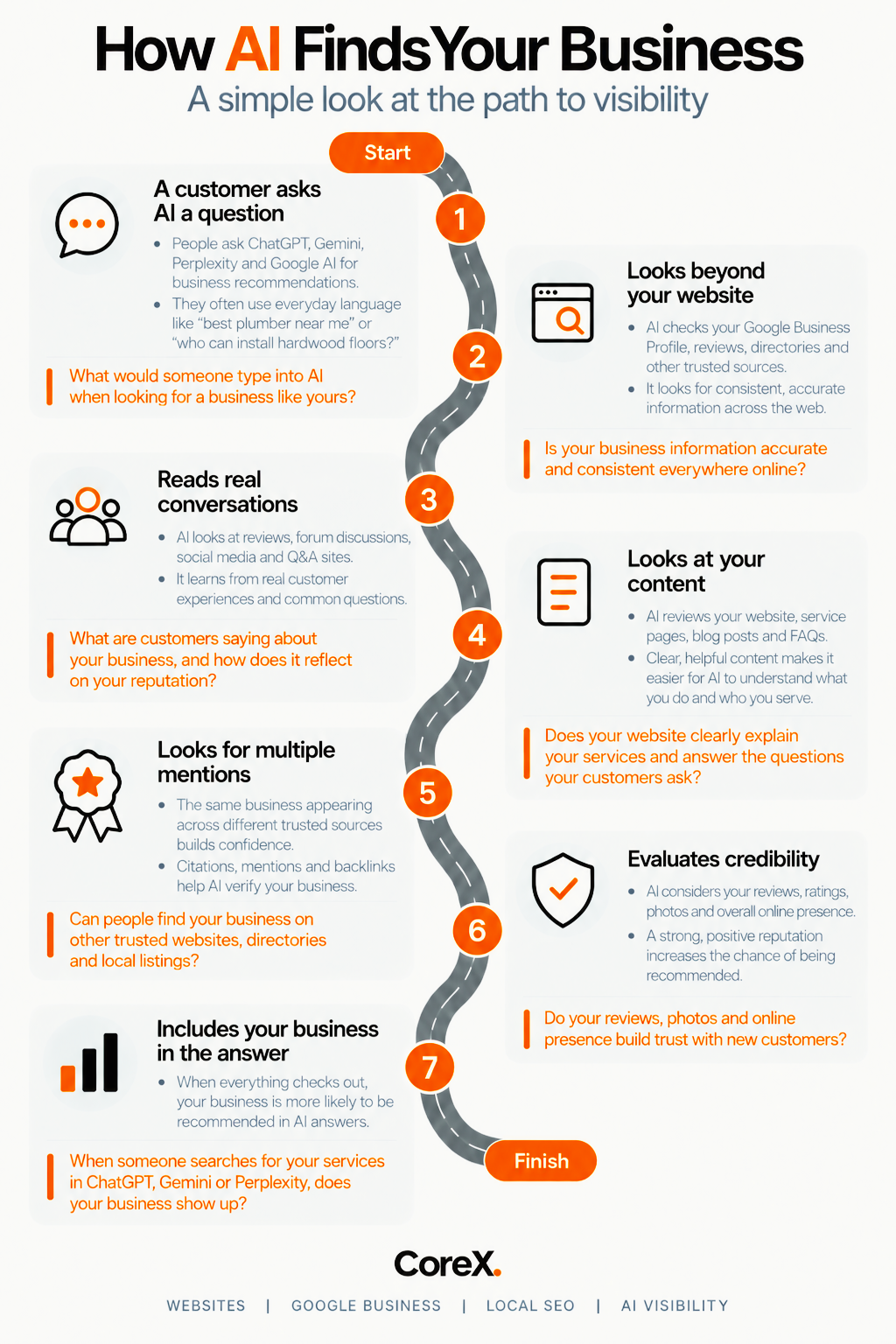
A note on this illustration: The seven areas above represent categories of information AI tools may draw from. They are not a step-by-step process that every tool follows, and AI tools do not guarantee a recommendation just because all seven areas look complete. Different platforms — ChatGPT, Perplexity, Google AI Overviews, Bing Copilot — each approach information differently. The areas below explain what you can actually control.
1. The questions customers ask
AI tools are built to answer questions in plain language. So they pay attention to whether your business information actually answers the questions people type in.
If someone asks "do you do same-day AC repair in Duluth?" and your website only says "HVAC services in Georgia," there's nothing specific to pull from. The same applies to a flooring company asked about installation timelines, or a cleaning service asked about commercial jobs.
Think about the last five questions a customer asked before booking. Write a short, direct answer to each one on your website — ideally on the relevant service page, not buried in an FAQ.
How to checkSearch your trade and city on ChatGPT. Read the response it gives. Does the information it pulls match what's actually on your website?
2. Your website content and service areas
Your website is usually the most detailed source of information you control. AI tools can read it. The more clearly it describes what you do and where you work, the more useful it is as a source.
What tends to help: pages that name the specific cities and counties you serve, describe the services you offer in plain terms, and make it easy to understand what makes your business different. What tends not to help: very short descriptions, pages that are mostly images, or copy that could belong to any business anywhere.
Example: A flooring company with a service page that says "serving Metro Atlanta" is less specific than one that mentions Roswell, Alpharetta, and Sandy Springs on the same page. When someone asks an AI tool for flooring installers in Sandy Springs, the more specific page gives the tool more to work with.
Check each of your service pages. Do they name the cities you cover? Do they describe what you actually do in clear terms? If not, add a short paragraph. A well-built service page doesn't need to be long — it needs to be specific.
How to checkSearch "[your trade] in [a city you serve]" in Google's AI Overview. If competitors appear and you don't, read their pages to see what they describe that you don't.
3. Business listings and accurate contact information
AI tools often pull basic facts — your name, address, phone number, hours — from multiple sources at once: Google, Apple Maps, Yelp, industry directories. When those sources agree, the picture is clear. When they don't, the tool has conflicting information and may present your business less confidently, or skip it.
Example: A cleaning company listed as "Fresh Start Cleaning" on Google, "Fresh Start Cleaning LLC" on Yelp, and an old phone number on a third directory is technically present everywhere — but each source describes a slightly different business.
Search your business name on Google. Check the panel that appears on the right side. Then check Yelp and Apple Maps. Your name, address, phone number, and hours should match exactly across all of them. Fix anything that doesn't.
How to checkA mismatch is usually visible when you look. The hardest part is finding all the places your business appears — start with Google, Yelp, Apple Maps, and Facebook.
4. Reviews and public discussions
Reviews are public. AI tools can access them. They're also written by real customers using real words — which means they often describe your business in the same language people search with.
A business with 50 recent, detailed Google reviews gives an AI tool substantially more context than one with 8 old reviews. Review recency also matters — recent activity signals that your business is currently operating, which affects how confidently an AI tool can describe you.
This applies broadly, not just to contractors. A landscaper, a cleaning company, a remodeling crew — all benefit from a consistent, growing base of public reviews.
After every completed job, ask the customer for a Google review. A short text message with a direct link to your profile works well. The key is asking consistently, not just occasionally.
How to checkSearch your business name in Perplexity. See whether it mentions reviews or quotes customer language. If your review count is low or your most recent review is over a year old, that's the first thing to address.
5. Relevant mentions on other websites
When other websites mention your business — a local chamber directory, a neighborhood site, a regional trade association, a community publication — that's independent confirmation that your business exists and is active in the area. AI tools can access those mentions.
You don't need a lot of them. A few genuine, publicly accessible mentions carry more weight than dozens of low-quality directory listings.
Make sure your business is listed in your local chamber of commerce directory. Check whether any neighborhood sites, trade associations, or regional directories are relevant to your area and industry.
How to checkSearch your business name in quotes on Google: "Your Business Name." See what comes up beyond your own website and Google profile. If nothing comes up, you have very little public mention outside your own platforms.
6. Credibility and supporting evidence
AI tools try to give accurate, reliable information. If your business is hard to verify — unclear address, phone number that doesn't match your website, no reviews, an incomplete Google profile — the tool may not include you, or may present your information with less confidence.
Credibility isn't about appearing authoritative. It's about being easy to verify. A completed Google Business Profile, consistent contact information, and a website that clearly describes what you do are the basics. Most businesses that struggle with AI visibility are missing one of those.
Complete your Google Business Profile fully — categories, services, hours, photos, description. Make sure the contact information there matches your website exactly. These two things are free to do and take less than an hour.
How to checkSearch your business name on Google. Read the knowledge panel carefully. Is everything current? Does the phone number match your website? Is the address correct?
7. Checking whether your business appears in AI answers
You can test this yourself, right now, for free.
Open ChatGPT, Perplexity, or Google and try:
- "[Your trade] in [your city]"
- "Best [your service] near [your neighborhood]"
- "[Your business name]" on its own
- "[What you do] open on weekends in [your city]"
Read what comes back. Does your business appear? Is the information accurate? If your business doesn't show up in any of these, the areas above — especially website clarity, listing consistency, and review count — are the most likely reasons.
Try the searches above. Take notes on which tools mention you, what they say, and what information they get right or wrong. Use that as your starting point. Our AI search visibility service includes a structured version of this process.
How to checkRepeat the searches every few months. Changes don't happen overnight — AI tools update their information on their own schedules — but consistent improvements to your information tend to produce better results over time.
Does having a website mean ChatGPT will recommend my business?
Not automatically. A website helps, but it needs to clearly communicate what you do and where you work. A simple five-page site with specific, honest content will generally be more useful to an AI tool than a large site that's vague or hard to read.
AI tools are also not directory services. They build responses from the information they've indexed across many sources — not just from your website alone. A business that appears in multiple credible sources is easier to describe confidently than one that appears only on its own website.
What's the difference between organic AI visibility and paid ads in AI tools?
Everything covered in this guide is about organic visibility — appearing naturally in AI-generated responses because your information is clear and accessible, not because you paid for placement.
Some AI platforms are developing advertising options for select businesses. Those paid placements work separately from organic results. Improving the areas above helps your organic visibility. It doesn't affect paid placement, and vice versa.
Practical checklist
AI Visibility Checklist for Small Businesses
- Website clearly states what you do, where you work, and how to contact you
- Service pages name the specific cities and counties you cover
- Business name, address, and phone number match across Google, Yelp, Apple Maps, and your website
- Google Business Profile is claimed, verified, and fully complete
- You're asking for Google reviews after every completed job
- Website content answers questions customers actually ask before booking
- Business is listed in at least one or two local directories beyond Google
- You've tested how your business appears in ChatGPT and Perplexity
Frequently asked questions
-
How long does it take to start appearing in AI search results?
There's no fixed timeline. AI tools update their indexes on their own schedules, and different platforms work differently. Improvements to your website content and business listings can take weeks or months to be reflected. The most reliable approach is to address the fundamentals — accurate listings, a clear website, recent reviews — and test periodically rather than expecting a specific date.
-
Is there a way to directly submit my business to ChatGPT or Perplexity?
Not in the way you'd submit a sitemap to Google Search Console. These tools gather information from the web rather than from a central submission process. The practical approach is to make sure your information is accurate, public, and accessible — which is what this guide covers. For Google's AI features specifically, ensuring your website follows Google's helpful content guidelines is the closest equivalent to an official path.
CoreX Solutions helps contractors and local service businesses across Metro Atlanta and Gwinnett County with website design, local SEO, Google Business Profile optimization, and AI search visibility. We're based in Peachtree Corners, GA.

